The Real Cost Breakdown of Building a Custom Home in Los Angeles (2026 Expert Guide)
Feb 20, 2026- 0 Comments
Building a custom home in Los Angeles is one of the most complex residential investments in the United States. Beyond architectural design, homeowners must navigate strict California building codes, advanced seismic engineering requirements, wildfire safety regulations, and some of the most demanding permitting processes in the country.
For this reason, working with an experienced Los Angeles custom home builder is essential to ensuring that design decisions align with real construction costs, regulatory approvals, and long-term project feasibility.
In 2026, most high-quality custom homes in Los Angeles typically fall within:
- $450 – $800+ per square foot (construction only).
- Ultra-luxury residences or hillside builds may exceed $1,000 per square foot.
However, construction cost is only one part of the equation. A realistic project budget must also account for soft costs, city fees, structural requirements, performance systems, and contingency planning.
Below is a detailed breakdown of what homeowners should expect when budgeting for a custom home build in LA.
Complete Cost Structure of a Custom Home in Los Angeles
1. Land Acquisition (If Not Already Owned)
In Los Angeles, land cost often represents 30–50% of the total investment.
Typical ranges (highly location-dependent):
- Valley lots: $250,000 – $700,000.
- West LA / Culver City: $800,000 – $1.8M.
- Beverly Hills / Brentwood: $2M+.
Key hidden factors:
- Soil reports.
- Slope analysis.
- Utility access.
- Easements and setbacks.
Land constraints directly impact engineering costs later.
2. Hard Construction Costs (40–55% of Total Budget)
This includes physical construction:
- Site work & grading.
- Foundation & concrete.
- Framing.
- Roofing.
- Windows & exterior systems.
- Mechanical, electrical, plumbing (MEP).
- Insulation (Title 24 compliant).
- Drywall, flooring, cabinetry.
- Exterior hardscape.
In LA, baseline construction typically starts around:
- $450–$550/sf for high-quality modern builds.
- $600–$800+/sf for premium finishes or complex sites.
Hillside properties significantly increase:
- Foundation costs.
- Retaining walls.
- Structural steel.
- Crane logistics.
3. Soft Costs (15–25% of Total Budget)
Soft costs are often underestimated.
They include:
- Architectural design.
- Structural engineering.
- Civil engineering.
- Title 24 energy compliance.
- Geotechnical reports.
- Surveying.
- Interior design.
- Landscape design.
- Permit processing.
For a $2M construction budget, soft costs can reach $300,000–$500,000+.
Design-build delivery can sometimes streamline this category by consolidating services.
4. Permits, Fees & City Requirements
Los Angeles permitting is one of the most expensive in California.
Costs vary depending on size and complexity, but may include:
- Plan check fees.
- Building permits.
- LADWP fees.
- Sewer connection fees.
- School district fees.
- Fire Department approvals.
- Haul route approvals (for hillside lots).
For a 3,500–4,000 sf custom home, permit-related costs can range:
$60,000 – $150,000+
Delays in permitting also increase carrying costs.
5. Structural & Seismic Engineering
California seismic codes require:
- Reinforced foundations.
- Shear walls.
- Steel moment frames (in modern designs).
Large open floor plans increase structural demands.
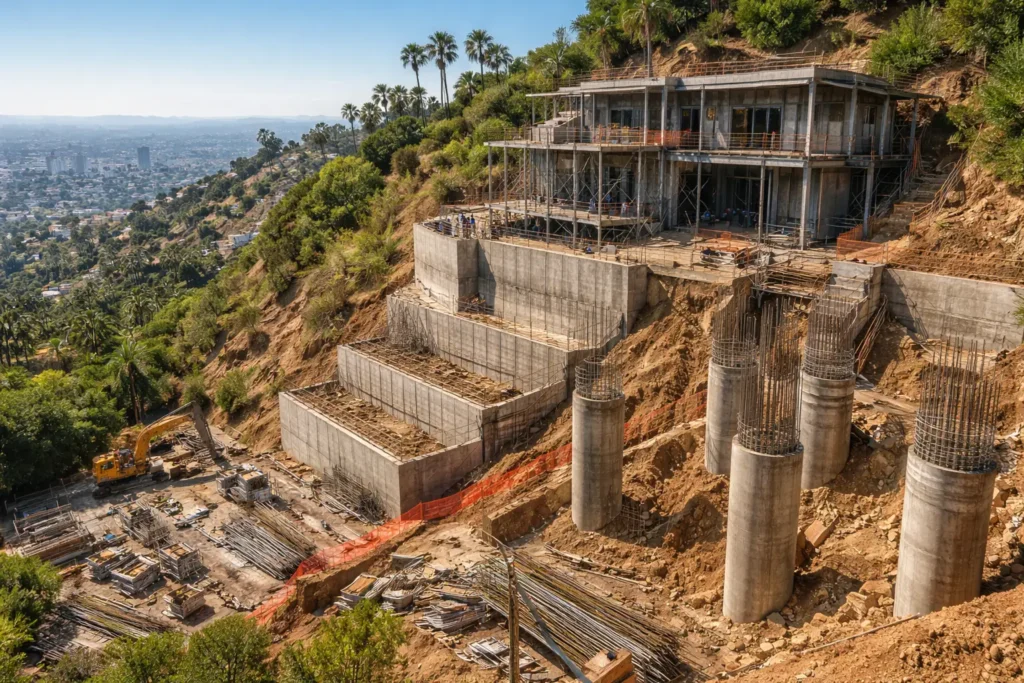
Hillside homes may require:
- Caissons.
- Grade beams.
- Extensive retaining systems.
Structural upgrades alone can add $100,000–$300,000 to complex projects.
6. High-Performance Systems & Energy Requirements
2026 homes in LA must meet advanced energy standards.
Common systems include:
- Solar panels (often required).
- Battery storage.
- High-efficiency HVAC.
- Advanced insulation.
- Smart home infrastructure.
These systems may add $50,000–$150,000, but improve resale value and operational efficiency.
7. Interior Finishes & Customization
Finishes create major cost variation.
Examples:
- Custom cabinetry: $80,000–$250,000.
- European windows: 2–3x standard cost.
- Luxury appliances: $25,000–$80,000.
- Natural stone slabs: $100+/sf.
Interior finish selection can shift a project budget by hundreds of thousands of dollars.
8. Landscaping, Pool & Exterior Features
Often overlooked during early budgeting.
Typical ranges:
- Basic landscaping: $40,000–$100,000.
- Luxury landscape design: $150,000+.
- Pool & spa: $80,000–$200,000+.
- Outdoor kitchen & hardscape: $50,000–$150,000.
In LA’s climate, outdoor living is considered part of the core design.
9. Contingency & Escalation
In Los Angeles, a realistic contingency is:
10–15% of construction budget
Especially important for:
- Unforeseen soil conditions.
- Material price fluctuations.
- Scope upgrades during construction.
Skipping contingency is one of the biggest financial risks in custom building.
Sample Budget Snapshot (4,000 sf Modern Home in LA)
While the chart above shows the proportional distribution of costs, the table below outlines the estimated dollar allocation for each major category.
Cost Distribution (Example Budget)
Based on a sample total project budget of $3.37M (excluding land).
| Category | Estimated Cost |
|---|---|
| Construction | $2.4M |
| Soft Costs | $400K |
| Permits & Fees | $120K |
| Landscaping & Pool | $200K |
| Contingency | $250K |
| Total (Excl. Land) | ~$3.37M |
What This Means for Homeowners
In most Los Angeles custom builds, construction accounts for roughly 70% of the total budget, while soft costs and regulatory fees represent a significant secondary layer of investment.
Ignoring these categories during early planning often leads to budget gaps later in the design process.
Land acquisition could easily push total investment beyond $4–5M depending on location.
Why Design-Build Impacts the Bottom Line
Traditional delivery separates architect and contractor, often leading to:
- Budget disconnects.
- Redesign costs.
- Change orders.
A design-build model provides:
- Early cost transparency.
- Value engineering before permits.
- Integrated scheduling.
- Reduced financial surprises.
In a market as complex as Los Angeles, this coordination significantly reduces risk.
Final Thoughts
Building a custom home in Los Angeles is not just a construction project — it’s a multi-layered financial strategy.
Understanding the full cost structure — from land and engineering to city fees and performance systems — is essential before committing to design.
When properly planned, a custom home in LA is not only a lifestyle investment but also a long-term asset in one of the most competitive real estate markets in the world.